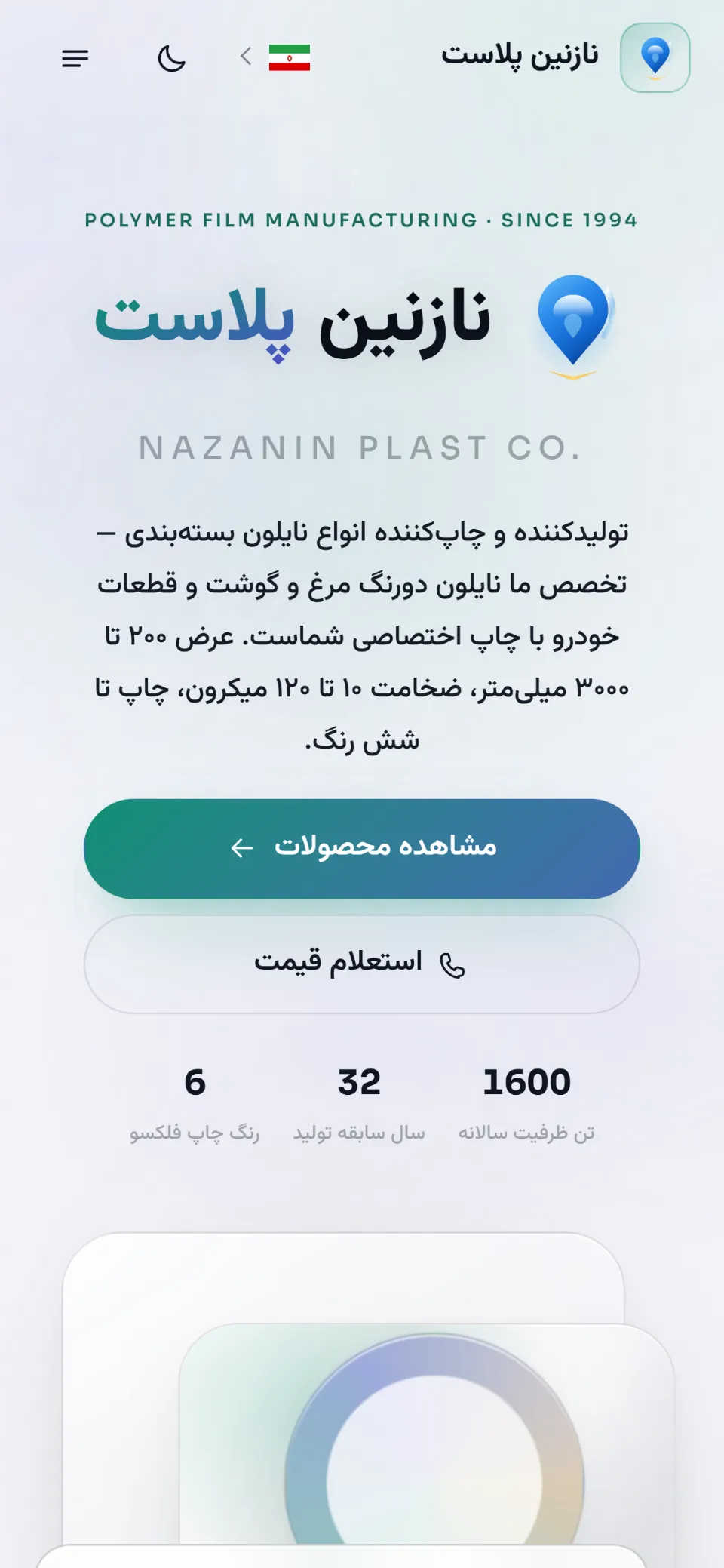
02Client project2026Live
Nazanin Plast
A catalogue and admin panel for a plastic-film factory in Meshginshahr.
- Role
- Brief, product decisions, testing on phones, deployment
- Built
- Sep 1, 2026 – Sep 22, 2026
- Type
- Client project
- Status
- Live
- Stack
- Node.js
- JavaScript
- CSS
- JSON-LD
- Netlify
- Netlify Forms
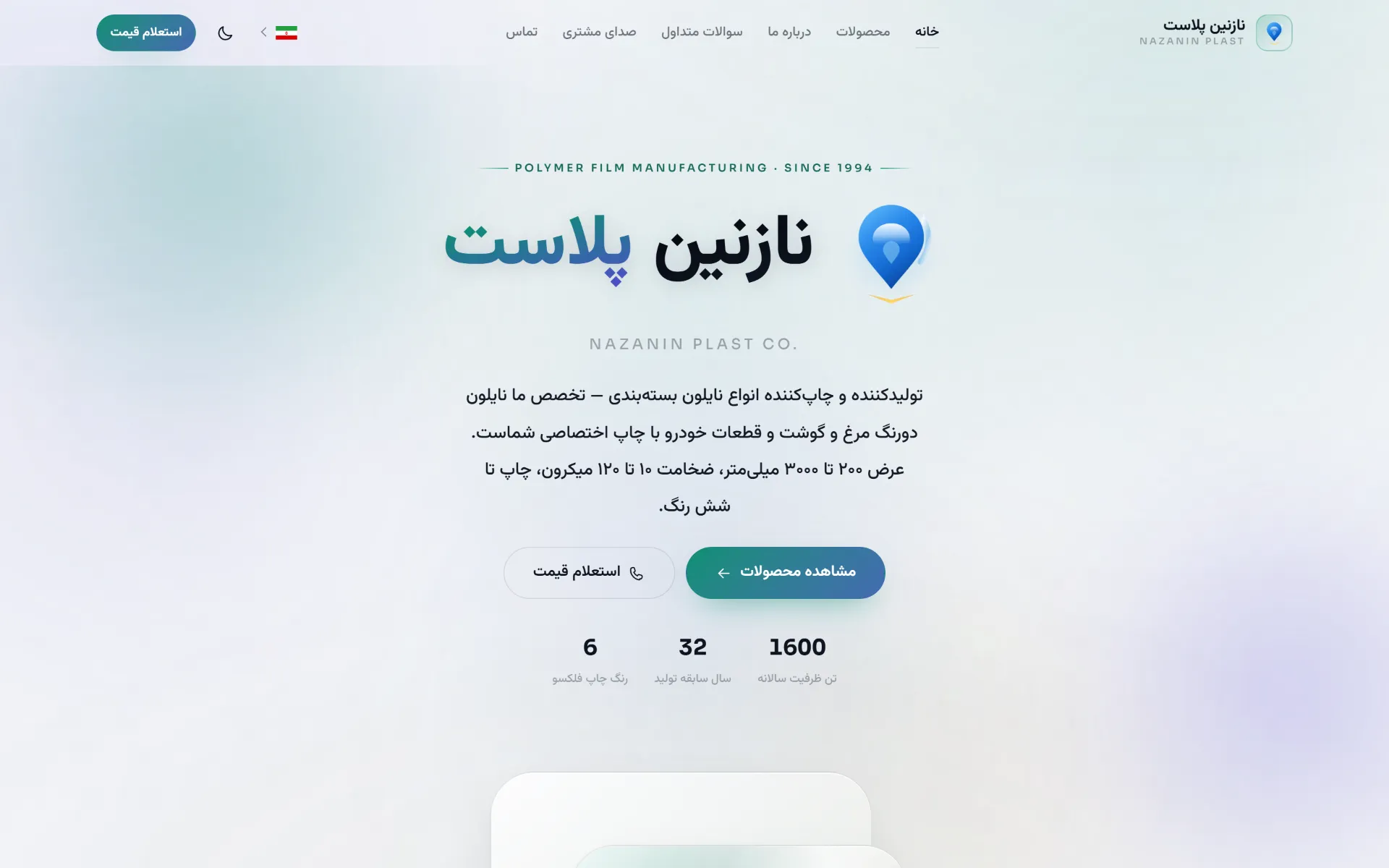
Nazanin Plast has made polyethylene film and printed bags since 1994. They wanted a site that shows the whole range (sizes, thicknesses, print options), takes price enquiries, and can be updated by the people who run the factory rather than by a developer.
Built with AI coding agents, under my direction. How I work
In numbers
- 4languages
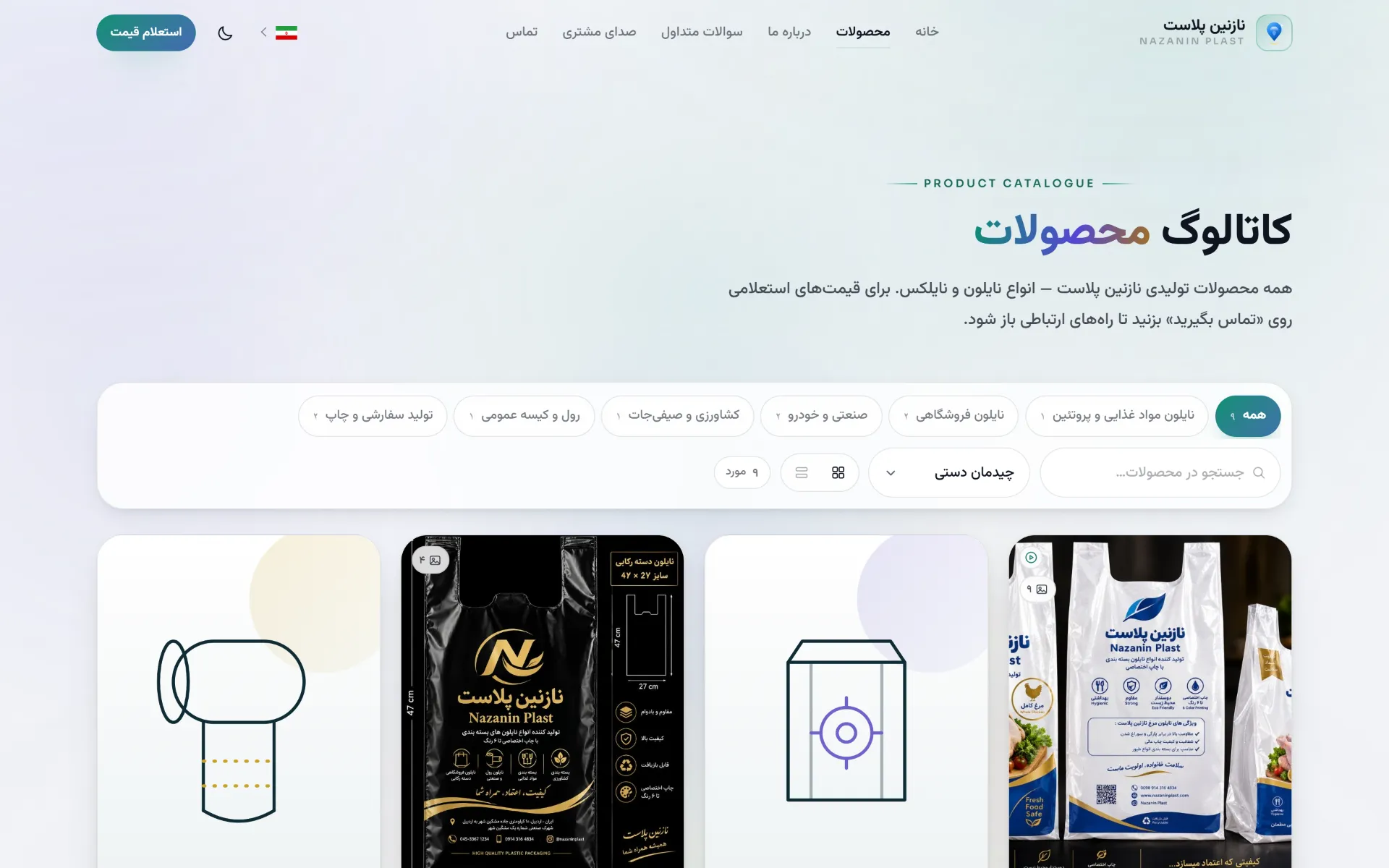
- 9products, 6 categories
- 25FAQ answers
- 0npm dependencies
What was built
- A public catalogue in Persian, English, Turkish and Arabic, with light and dark themes.
- A private admin panel: products, categories, a photo cropper, one video per product, prices or “call us”, an enquiry inbox and site settings.
- A customer-voice page for praise, suggestions and complaints, collected through Netlify Forms.
- A one-click builder that turns the whole site into static pages and a zip ready to drop on Netlify.
An entrance made of the product
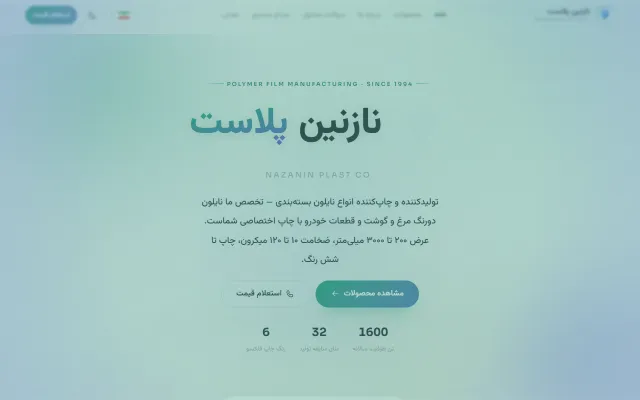
The factory makes blown film. Molten polyethylene is pushed through a ring-shaped die, rises as a narrow tube, and at the frost line balloons out into the bubble that becomes every bag they sell. The entrance animates exactly that with the company mark, a drop of melt: it climbs, inflates, and floods the screen with colour from the point where it lands.
It started at nearly eight seconds and ended at three and a quarter. The length was never what felt wrong; the abrupt last frame was. Now the site is revealed inside a colour that is already on screen.
 1
 2
 3
 4
How it works
The admin panel runs on the owner’s computer, on a Node.js server with no external packages. When content changes, the builder writes static pages with the real text already in the HTML for crawlers, generates the sitemap, robots.txt, structured data and Netlify’s headers and redirects, and packs the zip itself, because Windows’ built-in zip tool writes backslashes that Netlify reads as part of a file name.
Found and fixed
- A white page on phones. An animation ending on blur(0) kept the whole document on its own GPU layer, and a layer taller than the GPU’s maximum texture size (8,192 px on many devices) is never painted. Ending on none fixed it.
- Safari resumed a paused entrance from the wrong moment, so the entrance now does not exist until the button is pressed.
- The minifier once removed the spaces around + inside calc(). The font rule on the body became invalid, and the live site rendered in Times New Roman.
- The catalogue used to ride inside the HTML as 9 MB of base64. Now only tiny assets are inlined and photos stream in separately.
- On phones, nine decorative loops stop. They were nine reasons for the GPU never to rest.
Search and security
- Real URLs instead of hash routes, so every page can be indexed on its own.
- Structured data describing a manufacturer: its products, test standards, FAQ and opening hours.
- Titles that lead with what buyers type, not with a brand nobody searches for yet.
- Passwords stored only as scrypt hashes; six failed logins lock an IP out for ten minutes; the admin panel never goes online.