03Personal project2026In use
emap chat
A private chat, voice and screen-sharing app for my friends, relayed through my own server.
- Role
- Brief, product decisions, testing with friends, server and releases
- Built
- Sep 10, 2026 – Sep 13, 2026
- Type
- Personal project
- Status
- In use
- Stack
- Electron
- WebRTC
- Node.js
- WebSocket
- Inno Setup
- nginx
- systemd
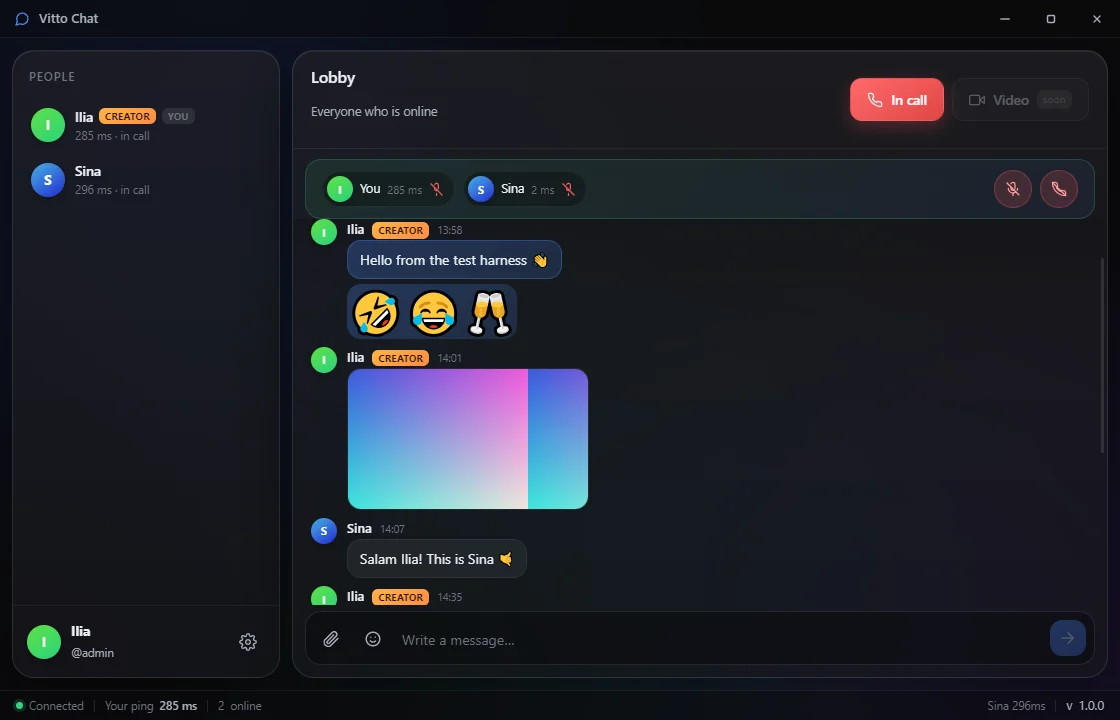
It started as Vitto Chat. In version 2.0 it became emap chat (emap is what our group calls itself), and the rule at its centre changed: the server now keeps the history, so nobody misses anything by being offline, and a fresh install still shows every message.
Built with AI coding agents, under my direction. How I work
In numbers
- 6people per call, peer-to-peer
- 4 GBshared storage for files
- 1command to ship an update
What it does
- Text, emoji, images, video, files and voice messages. A voice message draws its waveform while you speak, and you can play it back and scrub through it before deciding to send.
- Group voice calls for up to six people, with noise suppression, echo cancellation, push-to-talk and a global mute shortcut that works while the app sits behind other windows.
- View-only screen sharing, with live thumbnails to pick from and a watcher count for whoever is sharing.
- An owner console: approve new members, mute, kick with a reason the person is shown, announcements, an activity log and a feedback inbox.
How it works
A Windows app built with Electron talks to a relay on my Ubuntu server. Chat, presence and moderation travel as JSON frames over one WebSocket. Attachments go over plain HTTPS and are never pushed: a message shows what a file is and how big it is, and nothing downloads until someone asks. Voice and screen sharing are peer-to-peer WebRTC. The relay only swaps the offers and answers, so the audio delay is the distance between two friends, not the distance to the server.
Updates nobody has to send
Publishing is one command: it packages the app, builds the installer, hashes it and uploads it with a manifest. Every copy checks on launch, downloads the installer, verifies the hash, installs silently and restarts as the new version. The rename from Vitto Chat went the same way. The new installer finds the old app by its ID and removes it quietly, and the first launch carries the session across, so nobody was signed out.
Worth remembering
- Only people already in a call send the offer. If both sides offer at once, the two collide and neither connects, so the newcomer waits.
- Voice and screen are two meshes over one relay, so every signalling message says which one it belongs to. Without that they answer each other’s offers.
- element.hidden does nothing on an <svg>, because SVG lives in another namespace.
- Never pass /T to taskkill from the installer. The installer was started by the app, so killing the app’s process tree kills the installer with it.
- No native confirm(): it freezes the whole window. A styled dialog that returns a promise replaces it.